Let us compute the derivative of
using fourth order finite difference scheme
using periodic boundary conditions.
#%config InlineBackend.figure_format='svg'
from scipy.sparse import coo_matrix
from numpy import arange,pi,exp,sin,cos,ones,inf
from numpy.linalg import norm
from matplotlib.pyplot import figure,loglog,semilogy,text,grid,xlabel,ylabel,title
The differentiation matrix is anti-symmetric; we first construct the upper triangular part and get
The matrix is stored in coo_format which is a sparse matrix format.
The error in the derivative approximation is measured as
Nvec = 2**arange(3,13)
for N in Nvec:
    h = 2*pi/N
    x = -pi + arange(1,N+1)*h
    u = exp(sin(x))   # function values
    uprime = cos(x)*u # Exact derivative
    e = ones(N)
    e1 = arange(0,N)
    e2 = arange(1,N+1); e2[N-1]=0
    e3 = arange(2,N+2); e3[N-2]=0; e3[N-1]=1;
    D = coo_matrix((2*e/3,(e1,e2)),shape=(N,N)) \
        - coo_matrix((e/12,(e1,e3)),shape=(N,N))
    D = (D - D.T)/h
    error = norm(D@u-uprime,inf)
    loglog(N,error,'or')

loglog(Nvec,100*Nvec**(-4.0),'--')
text(105,5e-8,'$N^{-4}$')
grid(True); xlabel('N'); ylabel('error')
title('Convergence of fourth-order finite difference');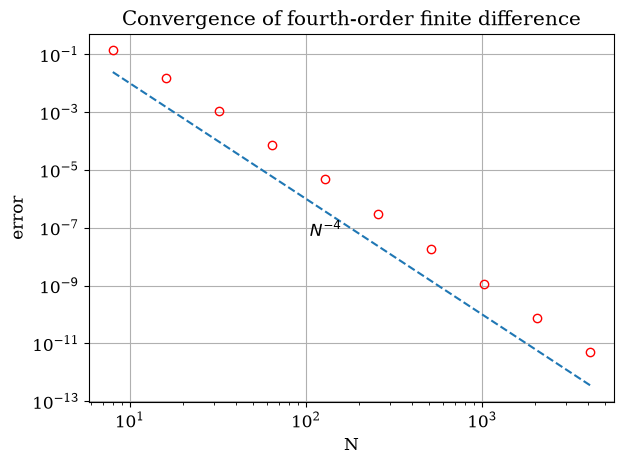
With about 4000 points, the error is of order 10-12.
Exercise
Find sixth and eigth order finite differences, implement them and make error plot as above.
Exercise
Construct the differentiation matrix using scipy.toeplitz function. You need to pass the first column and first row.